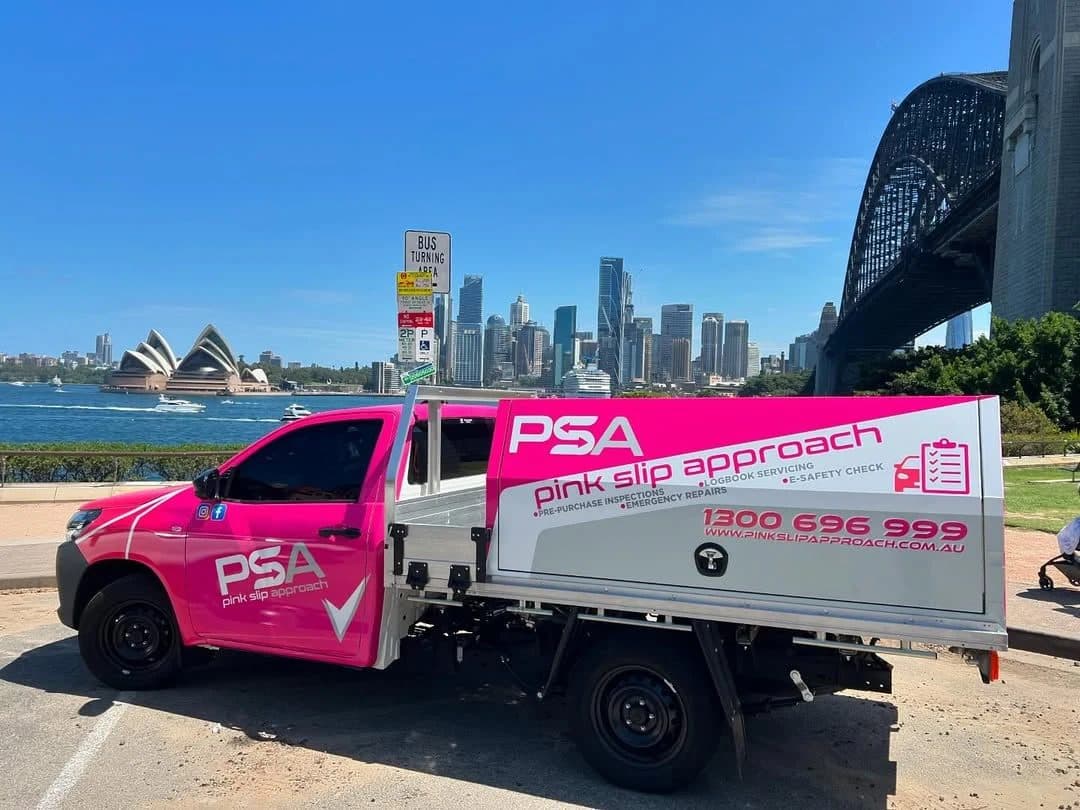
Only for the brakes. Most of a pink slip happens with the car standing still, but every first inspection (not a recheck after a fail) includes a brake test if it’s safe to do one, and the car can’t pass without it. On a mobile inspection that means a short drive on a suitable stretch of road and one hard stop.
The one part that moves
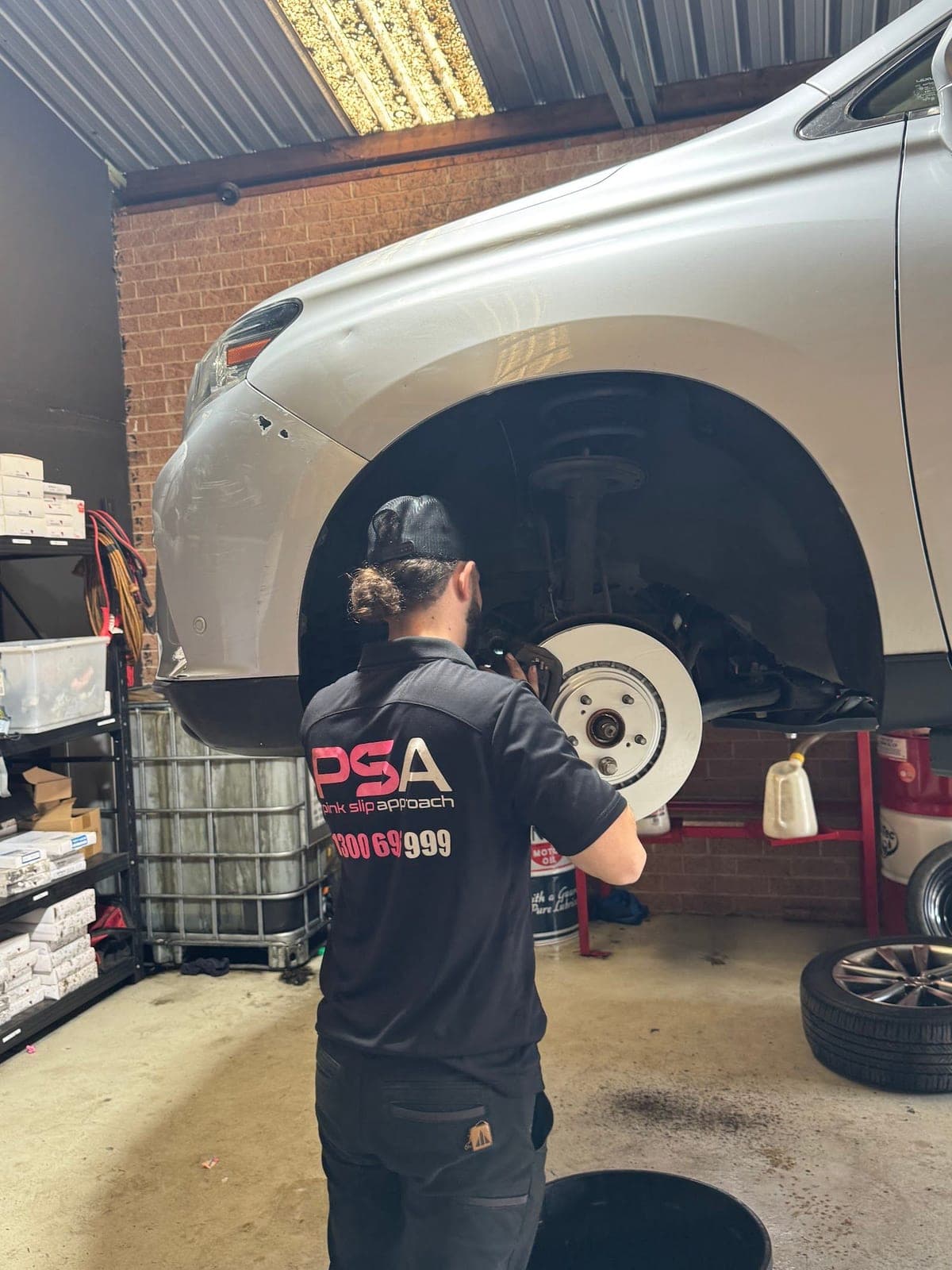
Most of a pink slip happens with the car standing still. The examiner, the technician doing the inspection, works around it and underneath it: tyres, steering, suspension, lights, the windscreen, seatbelts, leaks and rust. What can fail a pink slip has the full list.
The brakes are different. The rules say every first inspection includes a brake test if it’s safe to do one, and a car can’t pass without it. Looking at the pads and discs tells the examiner what condition the parts are in. The test tells them whether the car actually stops.
How the brakes are tested
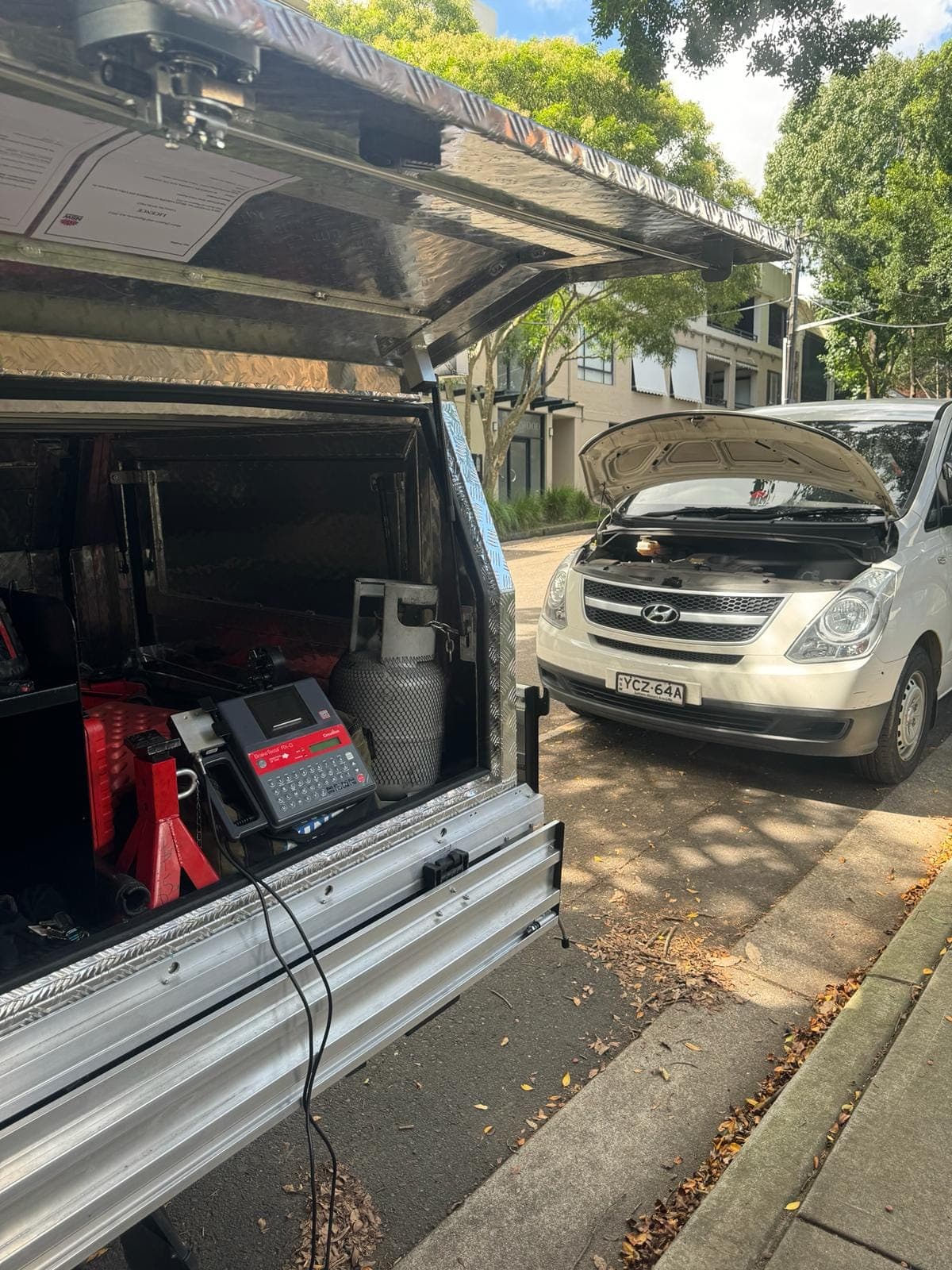
At an inspection station, the car can go on a roller brake tester or over a skid plate, or be tested on a road the station has nominated. A mobile inspection uses a decelerometer: a device in the cabin that measures how quickly the car slows down.
The examiner drives the car to at least 30 km/h, puts it in neutral and, with both hands on the wheel, brings it to a stop as quickly as is safe in one firm, steady press of the brake pedal. The car fails if it pulls away from a straight line, or if it doesn’t slow down as quickly as the standard requires.
On a mobile inspection the device has to be GPS enabled. It records the date, time and place of the test, the speed, the stopping distance and how hard the car slowed down. The examiner photographs the result in Transport for NSW’s R-Safety app, along with the car and its odometer.
Where a mobile brake test can happen
The examiner chooses the spot, and the rules for mobile inspections are specific about it. The stretch of road has to be:
- hard, level and sealed, with no gravel or other loose material on it
- at least 100 metres long and 2.5 metres wide
- clear of people, obstacles and heavy traffic
It can’t be within 500 metres of a school, a supervised school crossing or a school zone, signposted or not, and the test has to head away from them. It also can’t be near a pedestrian crossing or a busy area such as a shopping strip, a hospital or a business premises. A driveway or car park the public uses is ruled out, though private land is fine with the owner’s permission.
Before the test, the examiner does a risk assessment of the spot, as they do for the inspection site itself. All of it happens in daylight.
If the brakes aren’t safe to test
If the examiner finds the car so unsafe that braking hard would itself be dangerous, they don’t do the test. The car is failed so the owner can make the repairs, and it gets its brake test at the second inspection. If it’s dangerously defective, the examiner fails it as dangerous and tells you it mustn’t be driven until it’s repaired.
What to do after a failed pink slip covers the 14 days you get to fix a fail without paying a second inspection fee.
Why it can’t be done from photos
Photos you send in can’t replace the brake test. Its result carries a time, a place and a speed, and the examiner has to photograph it. Can you get a pink slip online? goes through the other checks that need the car in front of the examiner.
Booking one
Tell us when you book if the car is somewhere unusual, like a tight apartment car park or a steep driveway, so the technician knows what to expect before they arrive. How a mobile pink slip works covers the rest of the visit, and our pink slip page lists what to have ready.
When you’re ready, book now and you’ll see the price for your suburb before you pay.
Quick answers
Does a pink slip include a road test?
Only for the brakes. Every first inspection (not a recheck after a fail) includes a brake test if it’s safe to do one, and a car can’t pass without it. The rest of the inspection is done with the car standing still.
Will the technician drive my car?
Yes, a short way. On a mobile inspection the brake test is done on a suitable stretch of road, so if you won’t be there, leave the keys somewhere safe and tell us where when you book.
Where can a mobile brake test be done?
On a hard, level, sealed stretch at least 100 metres long and 2.5 metres wide, clear of people and heavy traffic, at least 500 metres from a school, and never on a driveway or car park the public uses.
Where these facts come from
- Transport for NSW, Light Vehicle Safety Check Standards (Section 2 of the AIS Rules) (opens in a new tab). Checked 26 October 2026.
- Transport for NSW, Business Rules for Authorised Proprietors and Authorised Examiners (Section 1 of the AIS Rules) (opens in a new tab). Checked 29 September 2026.
- Transport for NSW, Supplementary Business Rules for Mobile Safety Check (Pink Slip) Inspections, March 2026 (opens in a new tab). Checked 26 October 2026.