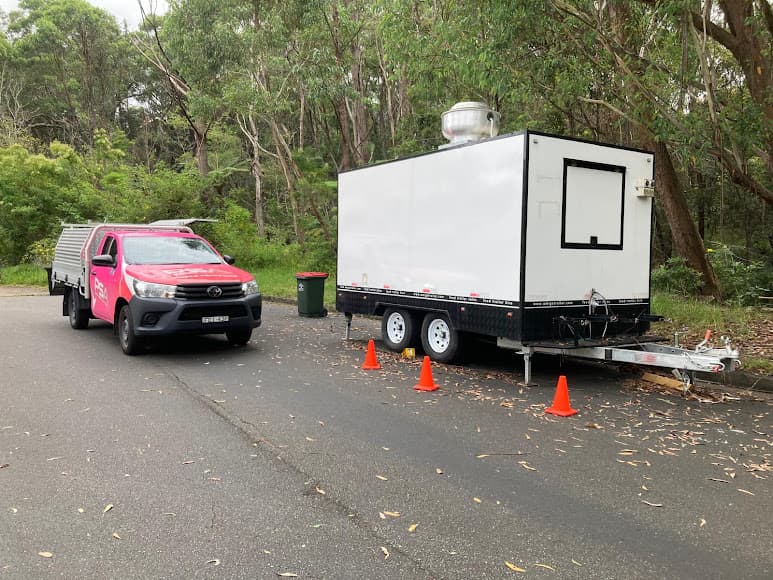
Trailers and caravans of 4.5 tonnes or less need a safety inspection each year once they are more than five years old, the same as a car. Small ones are exempt: caravans under 411kg tare, and trailers under 251kg tare without brakes.
Does your trailer or caravan need a pink slip?
Trailers and caravans with an aggregate trailer mass of 4.5 tonnes or less are light vehicles, and the same rule applies to them as to cars: more than five years old, and they need a safety inspection report each year before the registration can be renewed.
There are exemptions, and they catch a lot of the small stuff:
- caravans with a tare weight under 411kg
- trailers under 251kg tare without brakes
- some conditionally registered and historic vehicles
So the little box trailer you use twice a year may well be exempt, while the camper behind it is not. Check the tare weight on the compliance plate before you assume either way.
Trailers with air or vacuum breakaway braking systems are outside the light vehicle safety check as well.
What does a trailer inspection check?
The inspection follows the Transport for NSW standards for light trailers and caravans. It is a shorter list than a car, because there is no engine, but the things it does cover are the things that hurt people.
The coupling and drawbar
The most important part of a trailer is how it stays attached. It fails if any coupling component is loose or cracked, if the drawbar isn’t securely mounted or is cracked, or if mounting bolts and welds have advanced corrosion.
The coupling also has to display its gross mass rating and the manufacturer’s name or trademark. Worn couplings sometimes get replaced with something unmarked, and that is an automatic fail.
Safety chains
A trailer without breakaway brakes needs at least one safety chain or wire rope, permanently attached to the drawbar. It fails if a chain touches the ground, or is long enough to stop a breakaway device working, or is attached with shackles rather than permanently.
Chain and shackle sizes have to match the trailer’s mass, and the standards set a minimum for each weight range. Undersized chains on a heavier trailer are a common find.
Brakes
Where brakes are fitted, they have to work. Override brakes are tested by compressing the brake device and trying to move the trailer. Other brakes are tested hitched to the tow vehicle. The park brake gets the same treatment. Any visible brake component that leaks or isn’t securely mounted fails, as does a frayed or bared electric brake wire and a missing, broken or frayed brake cable.
Tyres, wheels and lights
Same standards as a car. Tyres are checked for tread depth and for cuts, bulges or exposed cords. Wheels fail if cracked or buckled, or if a nut or stud is missing. Every lamp and reflector has to work, which on a trailer means tail lights, brake lights, indicators, the number plate light and the rear reflectors.
Tare, ATM and why the numbers matter
Two weights decide whether your trailer needs an inspection, and they are not the same thing.
Tare is what the trailer weighs empty. It is the number in the exemptions: under 411kg for a caravan, under 251kg for a trailer without brakes.
Aggregate trailer mass, or ATM, is the most the trailer is allowed to weigh fully loaded, including what is on the tow ball. It is the number that decides whether it counts as a light trailer at all, at 4.5 tonnes or less.
Both are stamped on the compliance plate. If the plate is missing or unreadable, that is worth sorting out before an inspection rather than during one.
What tends to add cost
Trailers spend most of their life parked, and that is exactly why they fail. Things perish sitting still, and a van that has not moved since last summer is a different proposition from one that tows every month.
The items that often turn a trailer inspection into a bigger job are:
- Tyres. Trailer tyres usually age out before they wear out. A tyre with plenty of tread can still be past its life.
- Lamps and wiring. Trailer wiring lives outdoors, gets dragged over gutters and corrodes at the plug.
- Chains, couplings and fasteners. Rust that has gone past the surface, or a coupling that has been replaced at some point with one that carries no markings.
- Brakes. Where they are fitted, they have to work, and sitting idle does them no favours.
Caravans add the things a house has. Gas, water and internal wiring are not part of the safety check, but if the van has been sitting for a season, they are worth attending to while someone is already there.
Booking one
A trailer or caravan is the awkward case for a workshop visit. It has to be towed, which means hitching it, finding somewhere to park a long vehicle, and waiting with it. A mobile inspection removes all of that, and it is one of the reasons people book us for a van and a car in the same visit.
Pink Slip Approach does caravan and trailer pink slips across Cumberland and the rest of Sydney, south to Waterfall. You can book now, or read how a mobile pink slip works first.
Quick answers
Does my trailer need a pink slip?
If it is more than five years old and has an aggregate trailer mass of 4.5 tonnes or less, yes. Trailers under 251kg tare without brakes, and caravans under 411kg tare, are exempt.
Is a trailer inspection cheaper than a car?
Yes. Transport for NSW sets a lower maximum fee for trailers than for cars, and lower again for a trailer without brakes. A mobile provider charges the same inspection fee and can add a call-out fee.
What is checked on a trailer inspection?
The coupling and drawbar, safety chains, brakes where fitted, wheels and tyres, the body, and every lamp and reflector.
Where these facts come from
- NSW Government, eSafety checks (pink slips) and vehicle inspections (opens in a new tab). Checked 21 September 2026.
- NSW Government, Vehicle safety check and inspection fees (opens in a new tab). Checked 21 September 2026.
- Transport for NSW, Light Vehicle Safety Check Standards (Section 2 of the AIS Rules) (opens in a new tab). Checked 21 September 2026.